

Can a Business in Arizona Ban Firearms on Private Property? Understanding Property Rights and State Gun Laws
Key Takeaways
Property Rights and Firearm Restrictions
Arizona business owners can prohibit firearms on their private property. This applies even though the state allows constitutional carry without a permit. You should know that property owners use posted signs or verbal notices to communicate these restrictions.

Legal Methods of Enforcement
Businesses enforce gun bans through three main approaches:
- Posted signage at entrances
- Direct verbal communication
- Written company policies
Important Exception for Vehicles
You can store firearms in your locked personal vehicle in parking areas. State law protects this right under specific statutes, and employers cannot prevent you from keeping guns locked in your car.
Trespass Consequences
If you refuse to leave after being told firearms are not allowed, you may face criminal trespass charges. Law enforcement can arrest you for staying on the property after being asked to leave.
Factors That Affect Charges
Your criminal history matters in these situations. How you behave during the encounter also affects potential penalties. Additional alleged crimes will increase the severity of charges you might face.
Arizona's Broad Gun Rights—and How They Interact with Private Property Rules

Arizona ranks among the most firearm-friendly states in the country. The state allows permitless carry for law-abiding residents. Adults who are 21 or older can carry concealed firearms without needing a concealed weapons permit. Those who are 18 or older can carry openly as long as they are not prohibited from possessing guns.
State law stops cities and counties from creating their own firearm regulations. This means you follow the same rules whether you are in Phoenix, Tucson, or a small rural town. The state maintains control over gun laws to keep them uniform across Arizona.
Private property owners still hold authority over their own premises. A business can decide whether to allow firearms on its property. This right exists separately from what state law permits on public property or in general.
You might encounter firearm restrictions at various locations:
- Restaurants and bars that serve alcohol
- Retail stores and shopping centers
- Medical facilities and doctor's offices
- Office buildings and workplaces
- Entertainment venues and amusement parks
Business owners can post signs or verbally tell you that firearms are not allowed. If you refuse to leave when asked, you could face trespassing charges. While you can obtain a concealed weapons permit from the Arizona Department of Public Safety for reciprocity with other states, you do not need one to carry within Arizona itself. Your right to carry does not eliminate a property owner's right to set conditions for entry.
Can an Arizona Business Legally Ban Firearms on Its Private Property?

Yes, businesses in Arizona have the legal right to ban firearms on their property. As a private property owner or lawful occupant, you control who enters your premises and under what conditions.
Your authority to restrict firearms comes from basic property rights. You can set rules for access just like you would create a dress code or no-smoking policy. Customers who want to enter must follow your requirements.
Legal Framework Supporting Property Owner Rights:
- Criminal trespass laws give you the power to remove people who refuse to follow your rules
- You can ask someone to leave if they violate your firearms policy
- Refusing to leave after being asked becomes a criminal matter
Your business can enforce firearm restrictions through posted signs or verbal notice. When you tell someone they cannot bring a gun inside, they must comply or leave.
Vehicle Storage Exception:
Arizona law protects gun owners who store firearms in their personal vehicles. You cannot ban weapons that are:
- Lawfully possessed
- Locked in a privately owned car or motorcycle
- Located in your parking lot
This rule applies to both employees and customers. You can still prohibit firearms inside your building, but not in someone's locked vehicle outside.
Employee Policies:
You may restrict workers from carrying firearms inside your workplace. However, the vehicle storage protection means you cannot discipline employees for keeping lawful firearms locked in their personal cars in your parking area.
Retail stores, restaurants, medical offices, and other businesses throughout Arizona regularly exercise this right to control firearms on their property. Your policy must respect the vehicle storage exception, but you maintain broad authority over your indoor spaces.
How Businesses in Arizona Actually Give Notice: Signs, Policies, and Verbal Warnings

Arizona businesses use three main ways to tell you about their firearm rules: posted signs, written policies, and direct verbal instructions.
Posted Signs at Entrances
Most businesses that ban firearms will put up signs at their entrances. These signs usually have specific features to make sure you can see them:
- Clear words saying firearms or weapons are not allowed
- A picture of a gun inside a red circle with a line through it
- Placed at eye level near the front door
- Easy to see with contrasting colors
- Often at least 4×6 inches in size
Some Arizona businesses that serve alcohol must follow specific rules under state law about their firearm signs. For most other private businesses, owners can choose how to display their weapon policies as long as the signs are easy to see.
Written Employee Policies
Your employer can ban firearms through written policies in employee handbooks. These rules apply to workers even when there are no signs for customers. If you violate these policies, you could face discipline or lose your job.
Verbal Warnings from Staff
A business owner, manager, security guard, or police officer can tell you directly that you need to leave or remove your firearm. This verbal instruction carries the same weight as a posted sign. Once someone gives you this notice, you must follow it or you could face legal problems.
All three methods are valid ways for businesses to communicate their firearm policies to you.
What Happens If I Carry a Gun into a Business That Bans Firearms?
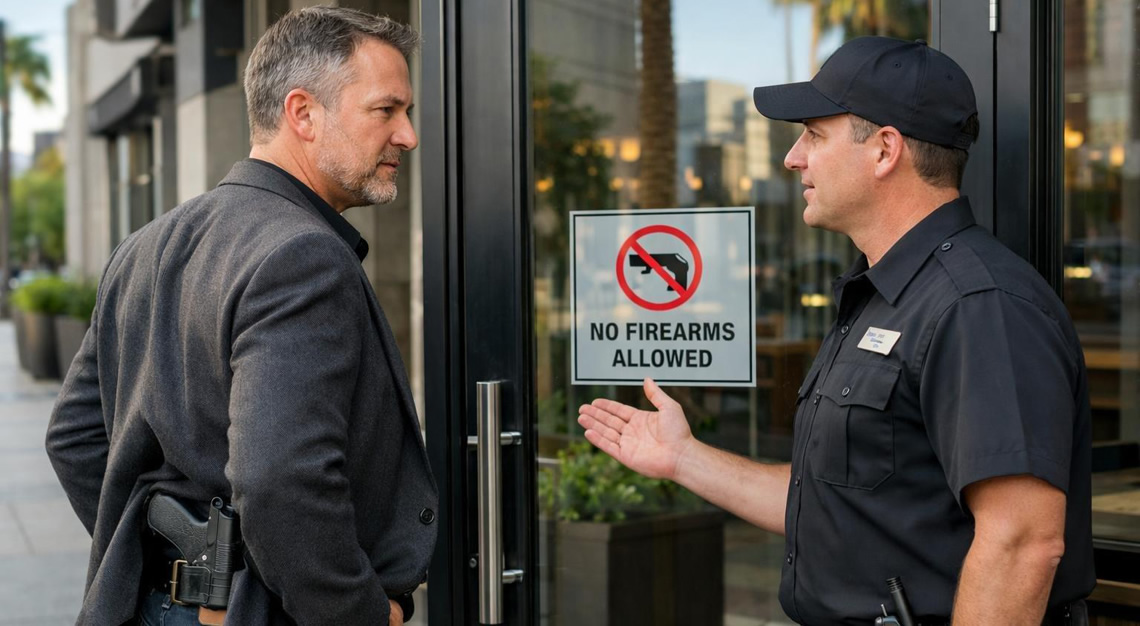
The outcome depends on whether staff notices you, how you respond, and if you break any other laws. Some people who carry firearms into businesses with bans are prohibited possessors under A.R.S. § 13-3102 or have domestic violence convictions. These factors make the situation more serious.
The Typical First Response
Staff or security will usually ask you to leave or remove your firearm before calling police. Many businesses prefer to handle the issue quietly without involving law enforcement.
If you comply right away, criminal charges are unlikely. You might return to your car to store the weapon or simply exit the property. The business may ban you from returning with a formal notice.
Higher Risks at Bars and Restaurants
Establishments that serve alcohol follow stricter rules under Arizona law. Ignoring posted warnings at these locations increases your legal exposure. A permit holder at a Tempe drinking establishment faced charges under A.R.S. § 13-3102 in 2022 after refusing to leave when asked. The court dismissed self-defense arguments because the property owner had the right to remove the person.
What Refusal Looks Like
Picture yourself entering a bar with a visible "No Firearms" sign while carrying concealed. A staff member spots your weapon and asks you to leave. Walking out immediately keeps the situation from getting worse. Arguing or refusing to go usually results in police involvement. This turns a simple property dispute into potential criminal trespass charges.
Your response determines whether you walk away without issues or face legal problems.
What Happens If You Don't Leave an Arizona Business That Bans Guns

When a business owner asks you to leave because you're carrying a firearm, refusing to go turns the situation into a criminal matter. Arizona's trespass laws apply once the property owner tells you to leave. Your right to carry a gun does not override a property owner's right to ask you to leave their premises.
The moment you refuse to leave, you can face criminal trespass charges. These charges have nothing to do with whether you legally own the gun. The crime is staying on private property after your permission to be there is taken away.
Arizona law breaks trespass offenses into three levels. Third-degree trespass is a Class 3 misdemeanor and can result in up to 30 days in jail and a $500 fine. Second-degree trespass is a Class 2 misdemeanor with penalties up to 4 months in jail and a $750 fine. First-degree trespass ranges from a Class 1 misdemeanor to a Class 6 felony, carrying up to 6 months in jail or 1-2 years in prison.
Your actions while refusing to leave matter. If you threaten employees, show your weapon in a threatening way, or use force, you may face additional criminal charges. These can include weapons misconduct or assault charges that elevate the situation to a felony.
When police arrive at a business where you've refused to leave, they typically:
- Take your weapon temporarily for safety reasons
- Look into whether other crimes occurred
- Decide whether to arrest you or issue a citation
Arizona courts have ruled that once a business properly tells you to leave, staying on the property is criminal trespass. Your status as a permit holder or retired law enforcement officer does not protect you from these charges.
A trespass conviction can damage your future. You may have trouble finding work or getting professional licenses. In some cases, it can affect your gun rights. If you're charged with trespass, contact a lawyer right away.
How Arizona Law Treats Firearms in Vehicles on Business Property
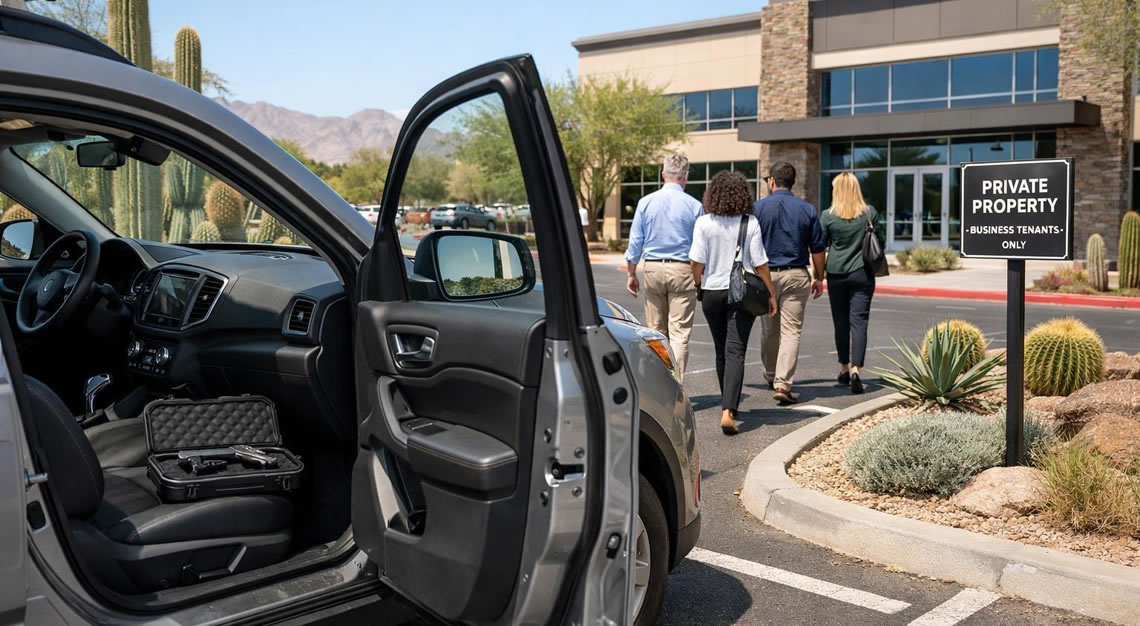
Arizona law gives you important rights when it comes to keeping guns in your personal vehicle at work. State law stops most employers from banning firearms that stay locked in your car while parked on company property. This means you don't have to give up your gun ownership rights just because you need to drive to your job.
Your vehicle counts as private space under Arizona law. As long as your firearm stays locked inside, out of sight, and your car is parked where you're allowed to be, your employer usually can't make rules against it. This applies to places like employee parking lots and other areas you have permission to access.
Important limitations exist:
- Employers control what happens inside their buildings
- Company-owned vehicles follow different rules
- Federal properties may have stricter requirements
- School grounds often have additional restrictions
Once you leave your car and enter the workplace, different rules apply. Business owners can ban guns from their indoor spaces completely. They can also prohibit firearms in vehicles they own, even if you take that work truck home at night.
Some employers require you to use a locked container or trunk for storage. Properties subject to federal oversight, like certain government facilities, may not follow standard state protections. The person in charge of security at these locations can enforce tighter controls.
Your rights protect storage in your personal vehicle. They don't extend to carrying firearms inside business buildings without permission.
Practical Tips for Arizona Gun Owners and Business Owners

Both groups can avoid legal problems by following simple steps and understanding their rights under state law.
If you carry a firearm:
- Look for signs that prohibit guns before you walk into any store, restaurant, or business. These notices usually appear near the front door at eye level.
- Ask an employee about the gun policy if you don't see clear signs posted.
- Leave right away if someone asks you to remove your weapon or exit the building. Staying calm and cooperating prevents trouble.
- Take a safety course to learn more about your legal duties as a gun owner in Arizona.
- Know that being responsible with firearms means understanding the places where you cannot legally carry.
If you own a business:
- Talk to a lawyer in Arizona to create a gun policy that follows state rules.
- Put up clear signs at every entrance customers use. Make sure the signs are easy to see and read.
- Teach your employees how to ask armed customers to leave in a safe, respectful way. Use calm phrases like "Our policy requires us to ask you to leave with your firearm."
- Keep records of any incidents where you asked someone to leave or gave written notice.
- Be aware that giving improper notice can lead to legal claims against your business.
Neither gun owners nor business operators should argue or raise their voices during these situations. If someone refuses to leave when asked, or if you believe there is a safety risk, contact police instead of handling it yourself. Training employees in calm communication helps prevent most conflicts from turning into serious problems.
Frequently Asked Questions

Can Arizona businesses make you store your gun with their security?
Private businesses sometimes offer storage options like secure lockers or check-in services. However, Arizona law does not require them to provide these facilities.
You cannot demand a check-in option if the business prefers a complete ban. If their policy states no firearms allowed, you must leave your gun outside the property or choose not to enter. Storing your firearm in your locked vehicle is one legal alternative.
Many businesses avoid offering storage because it creates liability and safety concerns. Managing someone else's weapon involves risk, so most owners prefer an outright prohibition instead.
Does concealment prevent legal problems if the business bans guns?
Carrying a hidden firearm into a posted business still breaks their policy, even if nobody sees it. You could face removal or a formal trespass notice if discovered later.
Criminal charges usually happen when the business learns about the weapon, asks you to leave, and you refuse. But knowingly entering with a concealed gun puts you at legal risk regardless of detection.
Responsible gun owners should honor posted rules and avoid entering restricted premises. This prevents future legal complications and respects property rights.
Can your landlord prohibit firearms in your rental unit?
Landlords sometimes try to ban weapons in rental properties through lease agreements. The enforceability of these clauses is complicated in Arizona.
Your rented unit becomes your home once you lease it. This creates strong privacy and self-defense interests under state law. Unlike commercial properties, residential units receive different legal treatment.
Arizona law generally favors tenant rights in housing situations. Some no-weapons clauses may not be enforceable due to policy considerations. The outcome depends on your specific lease language and circumstances.
Anyone facing a firearm restriction in their lease should speak with an attorney. The legal questions are complex and fact-specific.
What should you do if you miss a no-guns sign?
If you realize you entered a posted business with your firearm, leave immediately. Secure your weapon in your vehicle or go to a different location.
An honest mistake that you quickly correct is less likely to result in charges. This is especially true if you cooperate fully with staff or security.
Your intent, cooperation, and behavior matter significantly to law enforcement. Prosecutors consider these factors when deciding whether to file trespass charges.
How does a trespass arrest impact your gun ownership rights?
A single misdemeanor trespass conviction does not automatically eliminate your right to own firearms under Arizona or federal law. However, it can still create problems.
Background checks, employment screenings, and professional licenses may all be affected. You could face issues when seeking or renewing a concealed carry permit.
The situation becomes more serious if the incident involves additional factors. Threats, domestic violence designations, or felony charges can directly impact your gun rights. These consequences can be severe and long-lasting.
Anyone arrested or cited for firearm-related trespass should consult an attorney immediately. You need to understand both the immediate and future effects on your rights. Legal guidance helps protect your ability to possess firearms going forward.
When You Should Reach Out to a Criminal Defense Lawyer

You need to contact a criminal defense lawyer as soon as you are cited, arrested, or questioned about trespass or weapons charges. Getting legal help early can change the direction of your case before formal charges are filed.
Contact an attorney immediately if:
- Police want to question you about an incident on private property
- You received a citation for trespass or weapons misconduct
- You were arrested for firearm-related charges
- Property owners pressed charges after asking you to leave
Early legal representation gives your attorney time to review evidence, interview witnesses, and build a strong defense. Your lawyer can also communicate with prosecutors on your behalf and potentially prevent charges from being filed.
Whether you face a minor trespass citation or serious weapons charges, waiting to get legal help puts you at a disadvantage. Prosecutors begin building their case right away. You should do the same.
A criminal defense attorney understands Arizona law and local court procedures. They can explain your rights, review the facts of your situation, and develop a defense strategy that fits your specific circumstances.
Criminal charges affect your future in serious ways. Getting help from a lawyer who knows Arizona law makes a real difference in how your case moves forward.
Our lawyers provide complete
legal support from arrest through trial. We handle all court filings and represent you at every hearing. You get personalized attention for your specific situation.
Reach out to the criminal defense team at (602) 600-0447 to discuss your case. You can get legal advice that fits your specific circumstances and learn what steps to take next.


