

How Would a Federal Agent Contact You? Official Methods and What to Expect
Getting a visit from federal agents is one of the most stressful experiences you can face. When agents from the FBI, DEA, or other federal agencies show up at your door, call you on the phone, or approach you at work, it's natural to feel worried and uncertain about what to do next. How you respond in those first moments can have a major impact on your future.
Federal investigations often develop over months or even years before agents make contact with you. You might be contacted because you're under investigation, or you could be needed as a witness to someone else's case. Whatever the reason, understanding your rights and knowing the right steps to take is critical to protecting yourself from serious consequences.
An Introduction to Federal Investigations

Federal agencies like the FBI and Homeland Security Investigations work to enforce federal laws across the United States. These agencies investigate crimes that violate federal statutes, ranging from fraud and corruption to terrorism and threats against national security.
When you become part of a federal investigation, it means agents are gathering evidence related to a potential violation of federal law. You might be contacted as a suspect, witness, or victim. Federal agents use various methods to collect information, including interviews, surveillance, and document analysis.
Common types of federal investigations include:
- White collar crimes such as fraud and embezzlement
- Drug trafficking and organized crime
- Terrorism and national security threats
- Cybercrimes and identity theft
- Immigration violations
These investigations can last months or years before any charges are filed. Federal agents follow strict procedures while building cases, and their goal is to gather enough evidence to support prosecution in federal court.
The Simple Answer: No, You Should Not Talk to Federal Agents Without a Lawyer

The answer is clear and direct: never speak to federal agents without legal representation present. This rule applies to everyone, no matter if you think you are innocent or just a witness.
Why You Need to Protect Yourself
Federal agents from agencies like the FBI, IRS, DEA, or Department of Justice can show up at your door, your job, or call you on the phone without warning. These visits are not random. They happen as part of planned criminal investigations. When agents contact you, it often means you are connected to a case in some way.
You Have Important Rights
The Constitution gives you the right to stay silent and request an attorney before answering questions. Using these rights is not wrong or suspicious. It is a smart way to protect yourself from saying something that could hurt your case later.
The False Statement Trap
Under federal law (18 U.S.C. § 1001), lying to federal agents is a serious crime. You could face up to five years in prison for false statements. The problem is that even honest mistakes, forgotten details, or nervous responses can become criminal charges. Some people have been convicted only for what they said to agents, not for any other crime.
What You Should Do
When federal agents want to talk to you, you should:
- Stay calm and be polite
- Tell them you want to call a lawyer before answering questions
- Do not explain yourself or try to help
- Get contact information from the agents
- Leave the conversation as soon as possible
Anything you say to agents can be used against you in court. Even statements you think are helpful can become evidence of a crime. Federal cases are complicated, and only an attorney can guide you safely through an investigation.
Why Federal Agents Might Reach Out to You in Arizona

Arizona's location near the Mexican border and its growing economy create specific situations that draw federal attention. Your risk of contact depends on your profession, business type, and geographic location within the state.
Financial and Business-Related Cases
Federal investigators frequently examine financial crimes in Arizona's major cities. Medical professionals in Phoenix and Scottsdale face scrutiny for billing irregularities and insurance issues. Business owners in cash-heavy industries like restaurants, retail stores, and entertainment venues attract attention for potential tax problems. Investment professionals and financial advisors may encounter investigators looking into securities issues.
Border-Related Investigations
Your proximity to the international border increases the likelihood of certain types of federal contact. Agents investigate smuggling networks, substance distribution operations, and money movement across borders. These cases typically involve long-term surveillance before agents make direct contact. Immigration document issues, visa problems, and human smuggling cases also fall under federal authority in Arizona.
Technology and Online Crimes
Arizona's expanding tech industry and large retirement community create opportunities for digital investigations. Agents pursue cases involving stolen identities, computer-based fraud, and financial crimes committed online.
Government and Contract Work
If you work for government agencies or hold federal contracts, you face higher exposure to corruption investigations. Arizona receives substantial federal contracting dollars, which brings increased oversight.
Weapons and Civil Rights Cases
Federal firearms investigators target illegal weapons sales and trafficking networks, particularly those moving across state lines. Civil rights violations and bias-motivated incidents also trigger federal involvement.
Your Status May Not Be Clear
When agents contact you, they might not explain whether you're a witness, person of interest, or target. Federal law doesn't require them to clarify your status. They may downplay your involvement to encourage you to talk without legal representation.
Multiple Scenarios Possible
You could receive contact for any of these reasons:
- Information about someone else's activities
- Your own suspected involvement in federal violations
- Routine questioning related to your business or professional activities
- Background checks on associates or employees
Agents rarely make initial contact unless they've already gathered substantial information about the situation under review.
Your Rights and Options When Federal Agents Appear

When federal agents contact you, the Constitution protects you in specific ways. These protections exist whether agents approach you at home, your workplace, or any other location. The rights you hold during federal encounters mirror those you have with local police.
Actions You Are Legally Permitted to Take
Check who they claim to be. Ask agents to show you their credentials and badges. Real agents from organizations like the FBI or IRS will have proper identification. Write down their names and badge numbers. Ask for business cards showing how to contact them later.
Stay in control of the situation. Before speaking, ask whether they have a warrant to search or arrest. You can request this information without answering other questions. Recording details about which agency they represent helps protect you later.
Assert your right to remain silent. The Fifth Amendment protects you from having to answer questions. Tell agents clearly: "I want to speak to my lawyer." Once you say this, you've invoked both your right to remain silent and your right to legal counsel. These protections stop agents from requiring you to provide statements that could hurt your case.
Refuse consent to search your property. Without a warrant, agents need your permission to search. You can say no to searches of your home, vehicle, phone, computer, or financial records. This applies to all digital devices and business files. Refusing consent to search does not suggest guilt.
Keep agents outside your home. If agents want to talk but have no warrant, step outside and close the door. This prevents them from looking inside and claiming they saw something suspicious. What they observe in "plain view" can justify further action.
Write everything down. Document what agents say, what topics they ask about, and how many people are present. Note any attempts to question family members or employees. Your attorney will need these details.
Call an attorney right away. Federal cases move fast. Getting legal help early can change the outcome of your situation. Don't wait to see what happens next.
Actions Agents Are Legally Permitted to Take
The table below shows what federal agents can legally do during an investigation:
| Agent Authority |
Explanation |
| Contact you without warrants |
Agents can knock on your door, call you, or approach you at work without needing court approval |
| Use lies and deception |
Agents can mislead you to gather information, but lying to them creates criminal liability under federal law |
| Execute valid warrants |
Search warrants let agents enter property and take items listed in the document; arrest warrants allow custody |
| Observe from public areas |
Anything visible from public spaces can be photographed or used as evidence |
Question people who know you. Agents can interview neighbors, coworkers, relatives, and business contacts. They don't need your permission to gather information from others.
Use your words in court. Statements you make voluntarily become evidence. No conversation with federal agents is ever truly off the record. Even casual comments can appear in court documents later.
Monitor without warrants in certain situations. Some surveillance methods don't require court approval. Agents can watch your movements in public and photograph property from areas anyone can access.
Remember that remaining silent protects you. Speaking without legal counsel present creates risks that an attorney can help you avoid.
Critical Mistakes to Avoid

When federal agents make contact, your immediate actions determine whether you protect yourself or create legal problems. Each decision carries weight that can affect your future.
Allowing agents into your home without a valid warrant creates unnecessary risk. Once inside, everything visible becomes fair evidence. Papers on counters, screens displaying information, photos on walls, and conversations between family members can all be documented. Even if agents arrive to discuss an unrelated matter, they can use anything they observe.
Attempting to talk your way out of suspicion backfires in federal cases. You might think explaining your situation will clear things up quickly. Federal law operates under complicated rules that trained attorneys spend years studying. What sounds like innocent clarification often hands prosecutors the exact evidence they need.
Every conversation matters, including small talk before formal questioning begins. Agents learn advanced techniques for gathering information through casual dialogue. They're skilled at making people comfortable and getting them to share details. Your statements get written down and can appear in court proceedings later.
Providing false information carries separate criminal penalties regardless of any other charges. Under federal law, lying to agents is itself a felony that can result in prison time up to five years. Prosecutors don't need to prove you committed the crime they're investigating. The false statement alone violates the law and brings serious consequences.
Agreeing to device or document searches without legal guidance exposes far more than you realize. Phones and computers hold enormous amounts of personal data. When you give permission, agents can examine everything stored on those devices. They may discover evidence of completely different issues you weren't expecting them to find.
Signing paperwork without attorney review can surrender important protections. Agents may present forms that seem straightforward but contain legal language with significant implications. Consent forms and rights waivers can expand what agents are allowed to do or limit your ability to challenge their actions.
Talking about the contact with others before speaking to a lawyer complicates your situation. These conversations create more people who might be questioned. Different people remember discussions differently, which can lead to conflicting accounts. You might also unintentionally interfere with the investigation through these conversations.
What to Do When Federal Agents Show Up
When Agents Arrive at Your Home
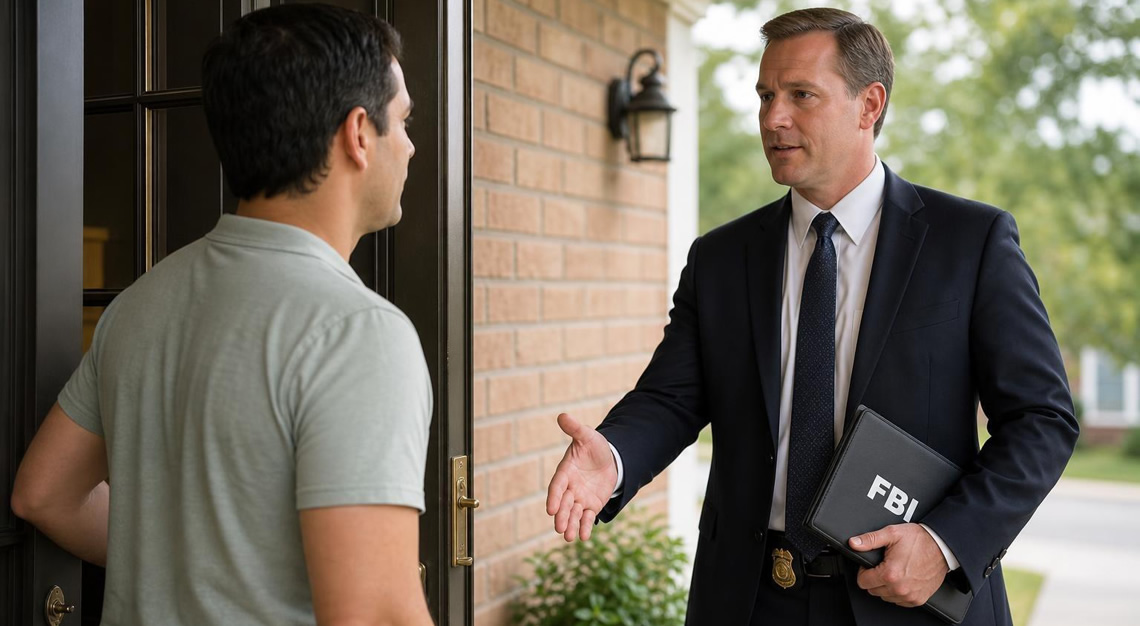
Do not open the door right away. Ask who is there while keeping the door closed. Federal agents will tell you their name and which agency they work for. You do not need to rush your response.
Request to see their credentials through a window or door viewer. Real agents expect this and will show you their badges and ID cards. Write down their badge numbers and names if you can see them clearly.
If they are legitimate federal agents, walk outside and shut the door. This keeps them from looking into your home and shows you are not giving permission to enter. You are not required to let them inside.
Ask these two important questions: "Am I being arrested?" and "Do you have a search warrant?" These questions help you understand the legal situation and what you must do.
Tell them clearly that you are using your constitutional rights. Say "I am choosing to stay silent and I want my attorney." This direct statement protects you under the Fifth and Sixth Amendments.
Get their contact details before they leave. Ask for business cards and tell them to reach out to your lawyer for any future talks. This sets up the right way to communicate going forward.
Call a criminal defense lawyer right after the agents leave. Contact an attorney as soon as they are gone. Federal investigations move fast, and getting legal help early often makes a big difference in your case.
When They Present a Search Warrant
Work with the search but keep your rights protected. Do not get in the way of their search because this can lead to federal obstruction charges. Working with them does not mean you have to talk or answer questions.
Look at the search warrant closely. Ask to read it so you know what locations they can search and what items they can take. A federal search warrant lists specific places and things they are allowed to access.
Write down as much as you can. Keep notes about what the agents do, what they say, which rooms they enter, and what they take with them. Your lawyer will need this information later.
Stay silent when they ask questions. You do not have to answer questions about the case, what you have been doing, or what other people have done. This is true even while they are searching your property.
Call your lawyer right away. Try to reach your attorney while the search is happening if you can. Many defense lawyers will talk directly to federal agents to protect their client's rights during the search.
Warning Signs of a Federal Investigation

Knowing what to look for can help you take action before federal agents reach out to you directly. These investigations often move quietly for months before targets become aware.
Federal agents question people close to you. When law enforcement contacts your coworkers, business partners, or family members, it usually means you are being looked into. FBI agents or IRS investigators asking questions about you is a clear signal.
You spot surveillance near your property. Unfamiliar cars parked on your street repeatedly or people watching your workplace might indicate federal surveillance. Law enforcement uses advanced methods to monitor people during serious cases.
Your bank or accountant receives federal requests. Financial institutions may contact you about subpoenas or information requests from federal agencies. When banks flag suspicious activity, it can start an investigation that brings more attention from authorities.
Here are common signs to watch for:
- Unknown vehicles appearing regularly near your home or office
- Unexpected questions from your bank about federal inquiries
- Strange behavior from your phone or computer
- Account access alerts you didn't trigger
- Communication issues with your devices
Your business relationships shift without warning. When partners or colleagues suddenly avoid you, they may have spoken with investigators. Some people start cooperating with federal agencies without telling you.
You receive grand jury subpoenas. These legal documents demand documents or testimony and show an active criminal investigation. You need legal help right away when this happens.
Federal agencies review your professional licenses. Audits or questions about your licenses often accompany larger criminal cases. These actions can threaten your career and income.
Technology shows signs of monitoring. Your devices acting strange, unexpected login notifications, or disrupted communications may point to surveillance. Federal agencies can track phones, computers, and online activity during investigations.
When you notice these signs, getting a lawyer should be your first step.
Why Arizona Residents Need Specialized Federal Defense

Arizona's location and economy create unique situations that bring federal law enforcement to the state more often than in other places. You face different challenges here that require a federal criminal defense attorney who knows both federal law and local court systems.
The border creates more federal activity. Federal agencies investigate immigration cases, drug movement, and weapons trafficking at higher rates in Arizona. DEA operations, ATF task forces, FBI offices, IRS criminal units, and homeland security teams all work throughout the state. These agencies often work together, which makes investigations more complicated than typical state cases.
Phoenix and Tucson attract federal attention for financial crimes. White collar crime units focus on these cities because of their growing business sectors. Healthcare fraud cases target doctors and medical facilities. Securities fraud investigations affect people in financial services.
Federal penalties are much more severe. Federal sentencing guidelines require harsher punishments than state courts give for similar crimes. Many federal offenses carry mandatory minimum prison terms that judges cannot reduce. Drug crimes and violent offenses often trigger these required sentences. Federal judges have less power to adjust sentences than state judges do.
Federal courts work differently than state courts. The District of Arizona follows federal procedures and rules that do not match state criminal proceedings. Federal prosecutors have bigger budgets and more tools than local district attorneys. They can bring charges that state prosecutors cannot file.
A federal criminal defense lawyer can help before charges are filed. Federal prosecutors decide whether to charge you based on their early review of the evidence. An experienced attorney can sometimes convince prosecutors not to file charges at all. They can also negotiate better outcomes before formal charges happen.
You need an attorney who understands federal criminal law and has experience in Arizona's federal courts. General criminal defense experience or state court practice does not prepare lawyers for federal cases. The consequences of federal charges are too serious to work with someone who lacks this specific knowledge.
Get Help from Phoenix Criminal Lawyer's Criminal Defense Attorneys

When federal agents reach out to you, time matters. Each day that passes limits your options and lets the investigation continue without legal protection. Government investigations advance fast, and getting a lawyer early can affect whether you face charges at all.
Phoenix Criminal Lawyer's criminal defense lawyers work on cases involving federal agencies across Arizona. If agents have contacted you or appeared at your home, call (602) 600-0447 right away. Schedule a consultation to talk about your case. We protect your rights, your freedom, and your future.
Don't wait to get legal help. The sooner you contact us, the better we can defend you.


