

How Do I Restore My Gun Rights in Arizona After a Domestic Violence Case: Legal Steps and Eligibility Requirements
A domestic violence case in Arizona can take away your right to own or carry a gun. This happens whether you got convicted of a misdemeanor, a felony, or even if a court issued a protective order against you. Both Arizona state law and federal law can restrict your gun rights, and getting those rights back is not simple.
The road to restoring your firearm rights requires you to work through two different legal systems. Each system has its own set of rules, waiting periods, and requirements. Understanding how a domestic violence case affects your gun ownership and what steps you need to take to restore those rights is important if you want to legally possess a firearm again.
What You Need to Know

Arizona law provides specific ways to regain your gun rights after a domestic violence case, but state approval does not guarantee federal compliance. The federal Lautenberg Amendment may still prohibit firearm possession regardless of state-level restoration.
Your path to restoration depends on several factors:
- Whether you were convicted of a misdemeanor or felony
- Whether domestic violence was an official element of your charge
- The type of sentence you received
- Any active protective orders against you
No automatic restoration exists. You must file a formal petition with the Arizona court and satisfy all waiting periods and eligibility requirements. The court evaluates each case individually.
Three main legal tools exist in Arizona: set-asides, civil rights restoration, and firearm rights restoration orders. Each serves a different purpose and carries different limitations.
Before you possess any firearm after a domestic violence conviction, you must consult with a criminal defense attorney. Possessing a gun without proper legal authorization is a serious felony in Arizona.
Domestic Violence Cases and Firearm Rights

A domestic violence conviction in Arizona can strip away your gun rights under both state and federal law. The penalties go beyond jail time and fines. You may lose your ability to own or carry firearms permanently.
Arizona treats domestic violence as a special label attached to other crimes. The state doesn't have a standalone domestic violence offense. Instead, crimes like assault, disorderly conduct, or criminal damage get tagged with a domestic violence designation when they involve certain people. These people include your spouse, former spouse, someone you live with, a romantic partner, a family member, or someone you share a child with.
When your conviction carries this domestic violence tag, you face extra consequences. The most serious is a federal firearm ban under the Lautenberg Amendment. This federal law blocks anyone with a qualifying domestic violence misdemeanor from owning, buying, or possessing guns or ammunition. The ban can last for the rest of your life.
Arizona law adds its own firearm restrictions on top of federal rules. You may face barriers under both systems. The state can take away your gun rights even if your conviction was for a misdemeanor. This creates two separate legal obstacles you need to overcome.
You can lose gun rights even before a conviction happens. Courts often issue protective orders in domestic violence cases. These orders can temporarily ban you from possessing firearms while they remain active. If you are subject to a final protective order that meets federal requirements, you cannot legally own guns during that time period.
A domestic violence misdemeanor can result in:
- Up to one year in jail
- Probation terms
- Required counseling programs
- Financial fines
- Permanent loss of gun ownership rights
The way your case gets resolved matters greatly. Some outcomes trigger lifetime firearm bans. Others may allow you to restore your rights after meeting specific requirements. Both state and federal laws control whether restoration is possible.
Your gun rights depend on which court handled your case and what exact charges you faced. The restoration process varies based on these factors. You need to understand both Arizona procedures and federal restrictions to know your options.
Arizona Domestic Violence Convictions and Their Impact on Gun Rights

Your gun rights in Arizona face serious restrictions after a domestic violence conviction. The severity depends on whether you received a misdemeanor or felony charge.
Misdemeanor Convictions
A misdemeanor domestic violence conviction can trigger federal prohibitions. When your case involves assault charges under A.R.S. § 13-3101 or similar offenses, you may lose your right to own firearms under federal law. This applies when your conviction includes the use of physical force or threatened use of a deadly weapon against someone in a domestic relationship.
Misdemeanor domestic violence cases make up roughly 70% of all DV filings in Arizona each year. This means thousands of people face potential federal firearm restrictions annually.

Felony Convictions
Felony domestic violence convictions, like aggravated assault with a domestic violence designation, trigger the federal ban on firearm possession. You become a prohibited possessor under federal law. Arizona law also removes your civil rights after a felony conviction under A.R.S. § 13-904. This includes your right to possess guns until a court restores these rights.
State vs. Federal Restrictions
You need to understand that Arizona and federal systems operate separately. A court in Arizona can restore your state civil rights through a legal process. However, this does not automatically remove federal restrictions.
The following table shows the key differences:
|
Level |
Arizona Law |
Federal Law |
|---|---|---|
|
Misdemeanor DV |
May allow possession after probation ends |
Lifetime ban unless expunged or pardoned |
|
Felony DV |
Rights lost until court restoration |
Separate federal prohibition remains |
You must address both state and federal requirements to lawfully own firearms again. Your Arizona gun rights restoration does not guarantee federal compliance.
Federal Law: The Lautenberg Amendment and Related Firearm Bans

Congress passed the Lautenberg Amendment in 1996 to address gun violence in domestic situations. Named after Senator Frank Lautenberg, this federal law creates a permanent firearm ban for people convicted of certain domestic violence misdemeanors. The law targets a specific problem: reducing deaths and injuries caused by guns in abusive relationships.
The amendment covers misdemeanor convictions involving domestic violence against various types of intimate partners. Originally, the law focused on spouses and people who lived together. The Bipartisan Safer Communities Act of 2022 changed this by adding dating partners to the list of protected individuals.
How Federal Law Prohibits Firearm Possession
Two main federal provisions control when you lose gun rights due to domestic violence situations:
|
Federal Law |
What Triggers the Ban |
|---|---|
|
18 U.S.C. § 922(g)(9) |
A conviction for a qualifying misdemeanor domestic violence offense |
|
18 U.S.C. § 922(g)(8) |
Being subject to certain domestic violence restraining orders after a hearing |
What Makes a Conviction Qualify
Not every domestic violence misdemeanor triggers the federal firearm ban. A conviction must meet specific requirements to fall under the Lautenberg Amendment.
The offense must have involved actual physical force, attempted physical force, or threats with a deadly weapon. You must have had a qualifying relationship with the victim. This includes current or former spouses, people you share a child with, people you lived with, or dating partners.
The conviction process must have included proper legal representation. Either you had a lawyer, or you knowingly gave up that right.
The U.S. Supreme Court ruled in United States v. Hayes that the original charge does not need to mention domestic violence by name. Courts can prove the qualifying relationship separately from the underlying offense.
Recent Changes Under the Bipartisan Safer Communities Act
The 2022 Bipartisan Safer Communities Act brought important changes. Dating partners now face the same firearm restrictions as married couples and people who live together. This expansion affects more people who were convicted of misdemeanor crimes involving romantic partners they did not marry or live with.
State Actions and Federal Background Checks
Arizona courts can set aside convictions or restore civil rights. These state-level actions do not automatically remove federal firearm prohibitions. The federal background check system follows its own rules about whether a state court order removes your gun disability. You remain prohibited unless your conviction is vacated, expunged, or meets specific federal requirements for removal.
Legal Pathways to Regain Gun Rights Following Domestic Violence Convictions in Arizona

Conviction Set-Aside Under A.R.S. § 13-905
You can request the court to set aside your conviction after you finish all parts of your sentence. This includes jail time, probation, fines, and any required counseling programs.
A set-aside releases you from most penalties connected to your conviction. The court views this action as proof that you have been rehabilitated. Your conviction stays on your record, but it shows as set aside.
Important limitation: A set-aside may not remove federal gun restrictions for domestic violence cases. Federal law has separate rules that often require different action.
Regaining Civil Rights Through A.R.S. §§ 13-905 and 13-910
If you have a felony domestic violence conviction, you can ask the court to restore your civil rights. You must wait a specific time period before you can apply.
The waiting period starts when you complete probation or get released from prison. How long you wait depends on your specific offense. Different crimes have different waiting requirements.
Key considerations:
- Firearm rights restoration depends on your specific offense
- Some felonies allow gun rights to be restored
- Other felonies may have permanent restrictions
- The court reviews each case individually
Limited Removal of Conviction Records
Arizona law allows expungement only for certain marijuana offenses under A.R.S. § 36-2862. Most domestic violence crimes do not qualify for this option.
You need to review your specific conviction to see what relief you can get. Each case is different and has different options available.
Changing Your Original Conviction
Sometimes the best approach is to modify your original conviction rather than just seeking restoration of firearm rights. You might be able to change your conviction to a non-domestic violence offense.
This change can remove federal gun restrictions more effectively than other methods. It requires strong legal work and depends on the details of your case.
Why this matters: Federal law bans gun ownership for domestic violence convictions. Changing the conviction type can eliminate this ban completely.
|
Method |
Changes Your Record |
Affects Federal Ban |
|---|---|---|
|
Set-aside |
Partially |
Maybe not |
|
Rights restoration |
No |
Sometimes |
|
Conviction modification |
Yes |
Yes |
Your specific situation determines which option works best. A lawyer can review whether modifying your conviction gives you better results than standard firearm rights restoration procedures.
Step-by-Step: How to Petition for Firearm Rights Restoration in Arizona Courts

Step 1: Collect Your Case Records
You need to gather all paperwork related to your case before moving forward. Pull together your court sentencing documents, minute entries, and proof that you finished probation or served jail time. You should also get certificates showing you completed any domestic violence counseling programs the court required. If any protective orders were issued against you, collect those too.
These records help establish exactly what charges you faced and what penalties the court imposed. They also show whether your case was officially classified as domestic violence.
Step 2: Find Out What Options You Have
Your next move is figuring out which legal remedies apply to your situation. An attorney can review your records and criminal background to identify the right approach. You might qualify for a set-aside, which erases certain convictions. If you have a felony, you may need civil rights restoration instead.
Other options include asking the court to reduce your charge or filing for post-conviction relief to remove the conviction entirely. Each path has different requirements and timelines.
Step 3: Submit Your Court Petition
You file your petition with the same court that sentenced you originally. This could be a justice court, municipal court, or superior court depending on your case. Your petition should include proof of rehabilitation like counseling completion certificates, work history, volunteer activities, and letters from people who can vouch for your character.
Most people wait about five years after finishing their sentence before filing. The court needs to see that you've made lasting changes.
Step 4: Participate in Your Court Hearing
The prosecutor can respond to your request, and the judge may schedule a hearing. You can speak at this hearing and bring witnesses who support your petition.
The judge will look at several things:
- How long ago the offense happened
- Whether you followed all court requirements
- Any new arrests or convictions since then
- Whether the victim opposes your petition
- Proof that you've changed your behavior
Your chances improve if you have a clean record since the original case and strong evidence of rehabilitation.
Step 5: Check Your Federal Status
Even if the Arizona court approves your request, you cannot immediately buy or own guns. Federal law operates separately from state law, and you need to verify your status in the National Instant Criminal Background Check System (NICS). This background check system determines whether federal restrictions still apply to you.
Have an attorney confirm that your court order actually removes federal prohibitions before attempting any firearm purchase.
How Active or Past Protective Orders Affect Gun Rights
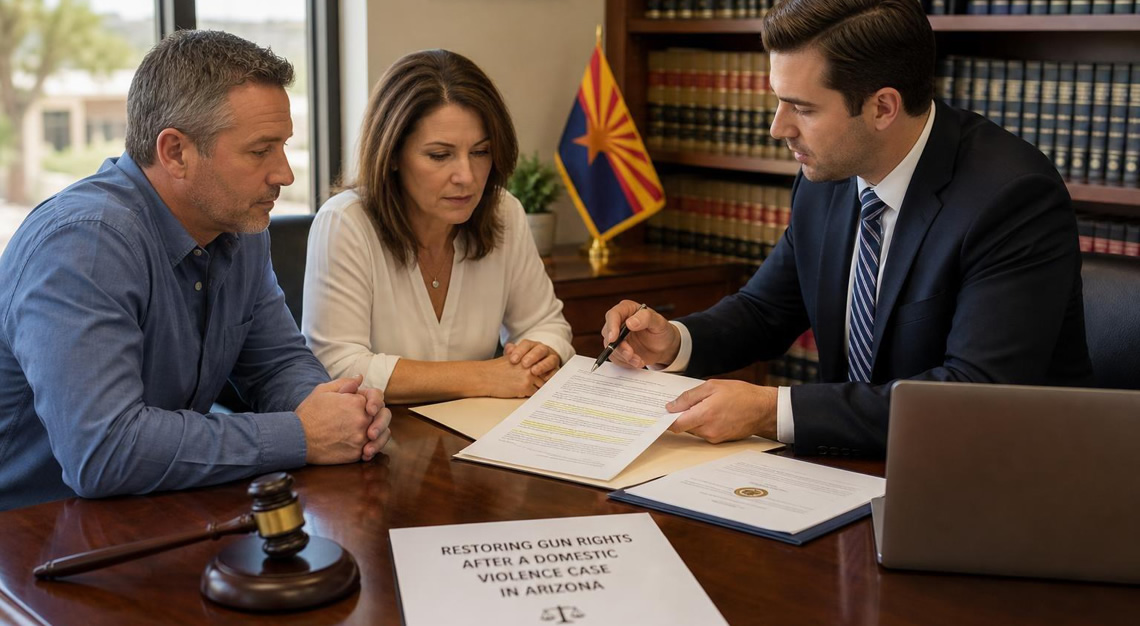
If you are subject to a protective order in Arizona, your ability to own or possess firearms may be restricted under federal law. The restrictions can apply while the order is active and may continue if violations or criminal charges occur.
Federal law under 18 U.S.C. § 922(g)(8) prohibits firearm possession for individuals under certain protective orders. The order must meet specific requirements to trigger this ban. It must restrain harassment, stalking, or threatening behavior against an intimate partner or child. You must have received notice and had a chance to participate in a court hearing. The court must have found that you pose a credible threat or the order must prohibit you from using physical force.
Arizona Orders of Protection, once finalized after a hearing, typically meet these federal requirements. The prohibition lasts as long as the order remains active.
Key impacts of protective orders on gun rights:
- Courts can order you to surrender firearms if they determine a credible threat exists
- Law enforcement may remove guns from your possession to protect the other person
- Violating firearm restrictions in a protective order can result in new criminal charges
- These violations create separate legal problems that affect your gun rights long-term
Compliance with firearm surrender requirements in Arizona stands at about 65% based on recent data. If you keep guns while prohibited, you risk federal criminal charges.
When a protective order expires or gets dismissed, some restrictions may end. However, any criminal conviction that resulted from the original case or from violating the order creates its own firearm prohibition. You must address these restrictions separately through the appropriate legal process.
Document all protective orders related to your case. Your attorney needs this information to determine what firearm restrictions apply to you and whether you can restore your rights.
Domestic Violence Incidents and Firearm Safety
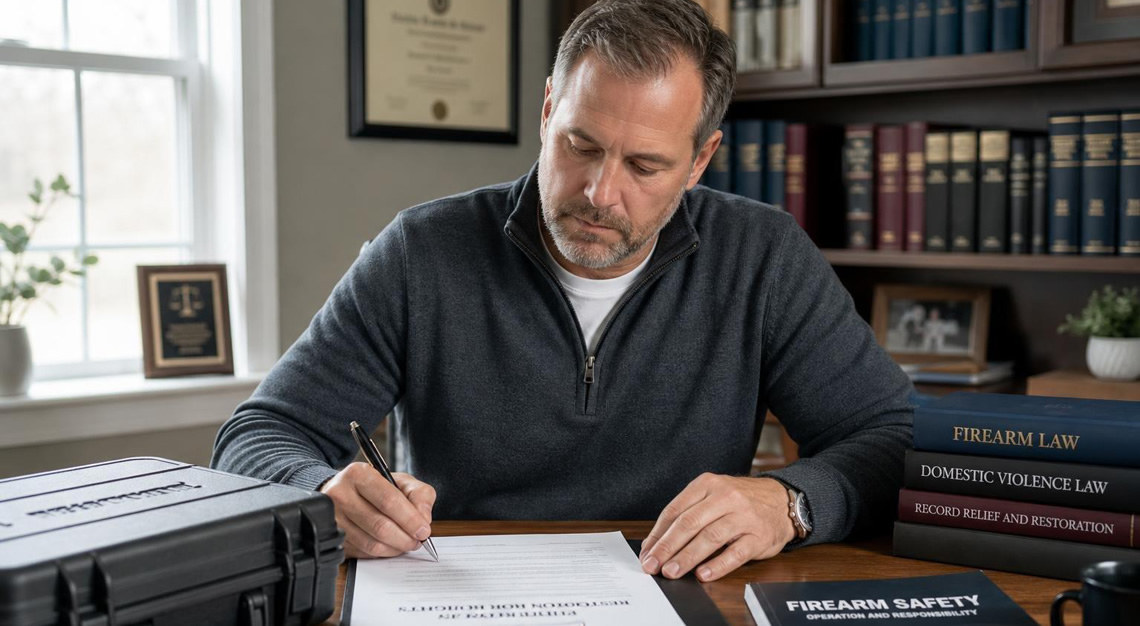
When firearms enter domestic violence situations, the danger increases significantly. Studies show that having a gun present during these incidents raises the risk of death for victims. This connection has led to specific laws that limit gun access for people who commit domestic violence crimes.
Federal Rules on Gun Possession
Federal law blocks certain people from owning guns after domestic violence convictions. The Lautenberg Amendment created a ban on gun ownership for anyone convicted of a misdemeanor domestic violence crime. This applies whether the crime involved actual physical force or threats with a weapon.
This ban covers many different relationships. You may lose your gun rights if you were convicted of domestic violence against:
- Current or former spouses
- Dating partners
- Other family members
- People you have a domestic relationship with
The Supreme Court has confirmed these restrictions are legal. The court recognized that these rules play an important role in keeping victims safe.
Closing Legal Gaps
The Bipartisan Safer Communities Act made federal law stronger by fixing what people called the "boyfriend loophole." Before this change, some dating partners who committed domestic violence could still own guns. Now the law treats abusive dating partners the same as other domestic violence offenders. This update reflects the reality that violence happens in all types of relationships, not just marriages.
State-Level Protections
Many states have added their own gun restrictions beyond federal rules. California stops people with domestic violence misdemeanor convictions from having firearms. South Dakota and West Virginia restrict gun access for people under protective orders or those convicted of misdemeanor stalking. These state laws work alongside federal rules to prevent situations from becoming deadly.
Police Response and Risk Assessment
When police respond to domestic violence calls, they check for firearms at the scene. Officers receive training to identify risk factors and may remove weapons when needed. Some situations allow police to enforce court orders requiring gun surrender.
Courts can issue protective orders that specifically ban gun possession. Judges often include these terms when someone has a history of violence or has made threats involving weapons.
Proven Safety Benefits
Research supports these gun restrictions. A detailed study examined multiple locations and found that limiting gun access for domestic violence offenders reduces deaths. The data shows clear benefits when both federal and state firearm bans are properly enforced.
Legal Tools for Protection
The combination of domestic violence laws and gun regulations creates important safety measures. Enforcement requires cooperation between courts, law enforcement, and community resources. When these systems work together, you have better protection from domestic violence escalation.
Supporting and understanding these legal protections helps create safer communities. The rules exist because evidence shows they save lives and prevent violent incidents from turning fatal.
Why You Should Work with an Arizona Criminal Defense Attorney

Getting your gun rights back after a domestic violence conviction involves understanding how Arizona state law works with federal gun laws. These two sets of rules do not always match up. Making a mistake could lead to new felony charges for having a gun when you are not allowed to.
A criminal defense attorney can pull your court records and review exactly what you were convicted of. They can explain if your case counts as a "misdemeanor crime of domestic violence" under federal rules. This matters because federal law can still ban you from owning guns even if Arizona restores your rights.
Your lawyer can find the best way forward for your situation. Sometimes a standard rights restoration petition is not the right choice. You might need a different approach, like changing your prior conviction to a non-domestic violence offense or fixing errors in your case records.
An attorney who knows Arizona law can file the right motions and paperwork. They understand how local prosecutors and police handle these cases. This knowledge helps you avoid problems.
Getting legal advice before you try to buy or carry a gun protects you from breaking state or federal law by accident. Federal penalties for illegally possessing a firearm can include up to 10 years in prison.
Common Questions About Gun Rights and Domestic Violence

Is It Possible to Regain Firearm Rights Following a Domestic Violence Misdemeanor in Arizona?
You might be able to get some relief under state law if you were convicted of a domestic violence misdemeanor. Arizona allows you to request a set-aside order in certain cases.
The problem is that federal law does not always recognize these state remedies. If your conviction fits the federal definition of a misdemeanor crime of domestic violence, you could still be banned from buying guns.
Recent federal changes also created a five-year ban on firearm purchase and possession for people convicted of domestic violence misdemeanors against someone they dated. Whether you can lawfully own a gun again depends on your exact conviction, the wording in your court records, and whether any legal action you take removes the elements that trigger the federal prohibition.
Will a Set-Aside or Rights Restoration in Arizona Remove Federal Gun Restrictions?
A set-aside or restoration of civil rights under Arizona law does not automatically remove federal firearm bans. Federal laws like the Lautenberg Amendment and felon-in-possession statutes remain in effect.
To clear federal restrictions, you typically need one of the following:
- Complete expungement of your conviction
- A set-aside that removes all legal disabilities
- A full pardon from the appropriate authority
The rules under the Gun Control Act are technical. Each case must be reviewed individually to determine if federal restrictions still apply.
Do Dismissed Cases or Diversion Programs Affect Your Gun Rights?
If your domestic violence charges were dismissed completely and you have no conviction or active protective order, federal law may not ban you from owning firearms. But other factors in your record could still create problems.
You need to look at your entire criminal history. Separate felony convictions or misdemeanor stalking charges from different cases can still prohibit gun possession.
Diversion programs and deferred prosecution agreements require careful review. Some of these arrangements create records that show admissions or dispositions that cause issues during background checks, even without a formal conviction.
What Is the Required Waiting Period for Rights Restoration After a Felony Domestic Violence Conviction?
The waiting period depends on several factors. These include your felony class, whether you served probation or prison time, and which specific rights you want restored.
Some rights can be restored as soon as you complete your supervision. Others require you to wait several more years after your case ends.
Your wait time increases if you have multiple felony convictions, used a deadly weapon, or committed serious physical assault. In some situations, you may find it extremely difficult or impossible to restore your firearm rights.
What Are the Legal Consequences of Possessing a Gun While Prohibited?
Knowingly possessing a firearm while you are prohibited creates serious legal problems. You can face new felony charges under both federal and Arizona law.
Federal penalties include up to 10 years in prison. Arizona charges carry their own severe consequences that affect your civil rights and future opportunities.
Even trying to buy a gun and failing the background check can attract law enforcement attention. Authorities often investigate denied purchases, especially in cases connected to domestic violence.
Get Help Restoring Your Gun Rights from Phoenix Criminal Lawyer

Facing domestic violence charges or convictions in Arizona can make understanding your gun rights difficult. Phoenix Criminal Lawyer Attorneys at Law offers clear guidance to help you through this process.
Our criminal defense team understands the legal challenges you face. We provide support tailored to your specific case and circumstances.
Contact our team at (602) 600-0447 to schedule a confidential consultation. We can discuss your options for restoring your gun rights after a domestic violence case in Arizona. Our attorneys will review your situation and explain the steps available to you.


