
Where Is It Illegal to Carry a Gun in Arizona: Restricted Locations and Legal Boundaries
Arizona allows most adults to carry guns without needing a permit. If you're 21 or older and legally allowed to own a firearm, you can carry it concealed or openly in most places. This makes Arizona one of the easier states for gun owners. However, the state still issues Arizona CCW permits for people who want extra benefits like faster purchases and the ability to carry in other states that recognize Arizona licenses.
Even though Arizona has relaxed gun laws, you still can't carry everywhere. State and federal laws create zones where guns are banned no matter what. Schools follow strict rules under both Arizona law and the Gun-Free School Zones Act. Government buildings, courthouses, and many private businesses also restrict firearms. Breaking these rules can lead to serious criminal charges, from misdemeanors to felonies that could take away your gun rights forever.
Carrying Firearms on Federal Lands and Buildings in Arizona
Federal Law Prohibiting Weapons in Government Facilities
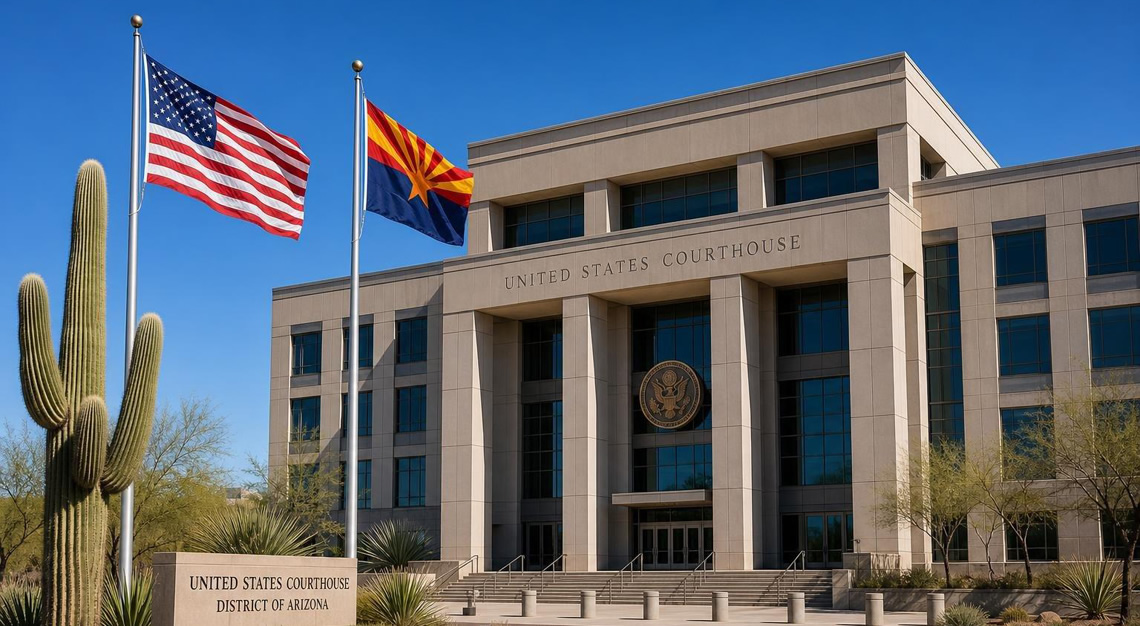
Federal law under 18 U.S.C. § 930 bans firearms and dangerous weapons inside federal facilities. A federal facility is any building or part of a building owned or leased by the federal government where federal employees regularly work.
The law applies even if you have an Arizona concealed carry permit. Very few exceptions exist, mainly for law enforcement officers, military personnel, and specific authorized federal workers.
You cannot carry firearms in these common federal locations in Arizona:
- U.S. District Courts
- Federal agency offices
- VA Medical Centers
- Federal administrative buildings
- Probation and parole offices
U.S. Postal Service Buildings and Parking Areas
Post offices enforce strict federal regulations against firearms. You cannot carry guns inside postal buildings or on postal property, which often includes parking lots. This applies whether you carry openly or concealed.
Federal courts have upheld these restrictions. People with valid state permits have been convicted for bringing firearms into federal postal facilities.

Required Signage at Federal Buildings
Federal law requires visible notices at public entrances to federal facilities under 18 U.S.C. § 930(h). These signs must inform visitors that firearms are prohibited.
The absence of proper signage may affect a criminal case. However, you should not assume that missing signs make carrying legal. Consult an attorney if you face charges related to this issue.
National Parks and Forest Lands Under Federal Control
National parks and national forests in Arizona follow state gun laws for outdoor areas. Federal law changed in 2009 to allow firearms in these spaces if you comply with Arizona carry laws.
You can legally carry in outdoor portions of parks like Saguaro National Park and Grand Canyon National Park. Follow Arizona's rules for how you carry.
Federal buildings within parks still prohibit firearms:
- Visitor centers
- Ranger stations
- Administrative offices with posted notices
- Federal restrooms
- Caves and enclosed natural areas under federal management
Penalties for Federal Gun Law Violations
Federal charges can result from violations on federal property. Consequences include possible permanent loss of gun rights and jail time.
Carrying a firearm in a federal facility can lead to misdemeanor charges. Penalties may include up to one year in jail and fines reaching $100,000. Even accidental violations can trigger federal prosecution.
If you are under investigation for a federal firearm violation, seek legal counsel immediately. Federal cases differ significantly from state cases and require experienced representation.
Firearms in Public Buildings, Courts, and Police Offices
Public Building Rules
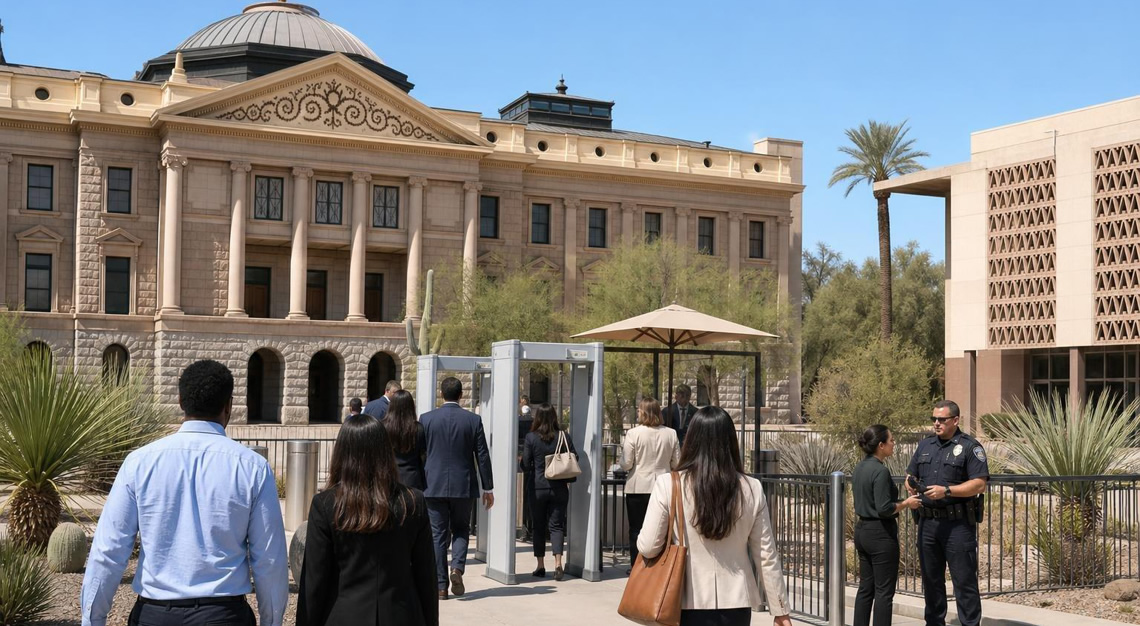
Arizona law prevents you from carrying guns in many government facilities. Buildings that ban firearms must offer secure storage options like weapon lockers at the entrance.
You cannot bring guns into these locations:
- State office buildings
- County government centers
- City halls
- Capitol complex offices in Phoenix
When you visit these buildings, you need to check your weapon at security before entering. Staff will direct you to storage areas where available.
Court Building Rules
All Arizona court facilities restrict firearms once you pass security checkpoints. This includes superior courts, justice courts, and municipal courts.
Some courthouses ban guns in the entire building. Your concealed carry permit does not change these rules. You must leave your weapon at home or in your vehicle when attending court.
Police Station Rules
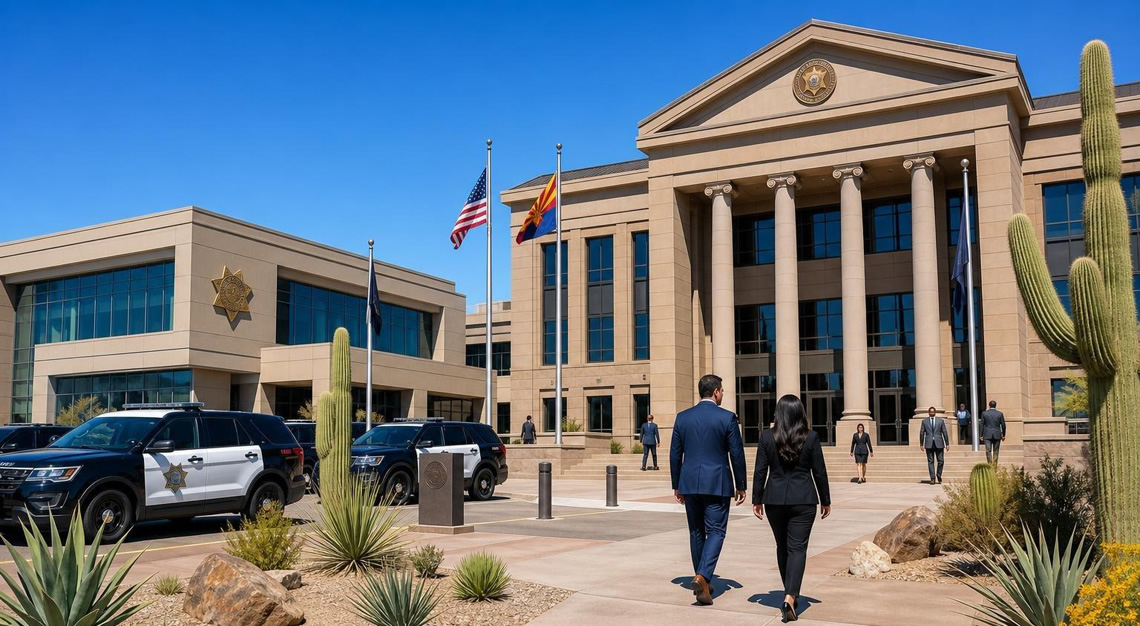
Police departments, sheriff's offices, and Department of Public Safety locations limit firearms in specific areas:
- Secure zones
- Jail cells
- Interview spaces
- Evidence storage rooms
Active duty officers can carry firearms in these buildings. Retired officers with proper identification may also qualify for exceptions. However, both groups still face some restrictions depending on the area.
Legal Consequences
Bringing a gun past security in a government building can lead to arrest. You may face charges for misconduct with weapons. Additional charges might include interfering with law enforcement or court operations.
Each building has different policies. Some offer weapon storage while others do not allow firearms at all. Posted signs indicate where guns are prohibited.
Check the rules before you visit any government property. County, state, and city buildings may have different requirements. When in doubt, contact the facility ahead of time to ask about their firearm policy.
Gatherings, Public Spaces, and Commercial Properties in Arizona
Ticketed Venues and Organized Events
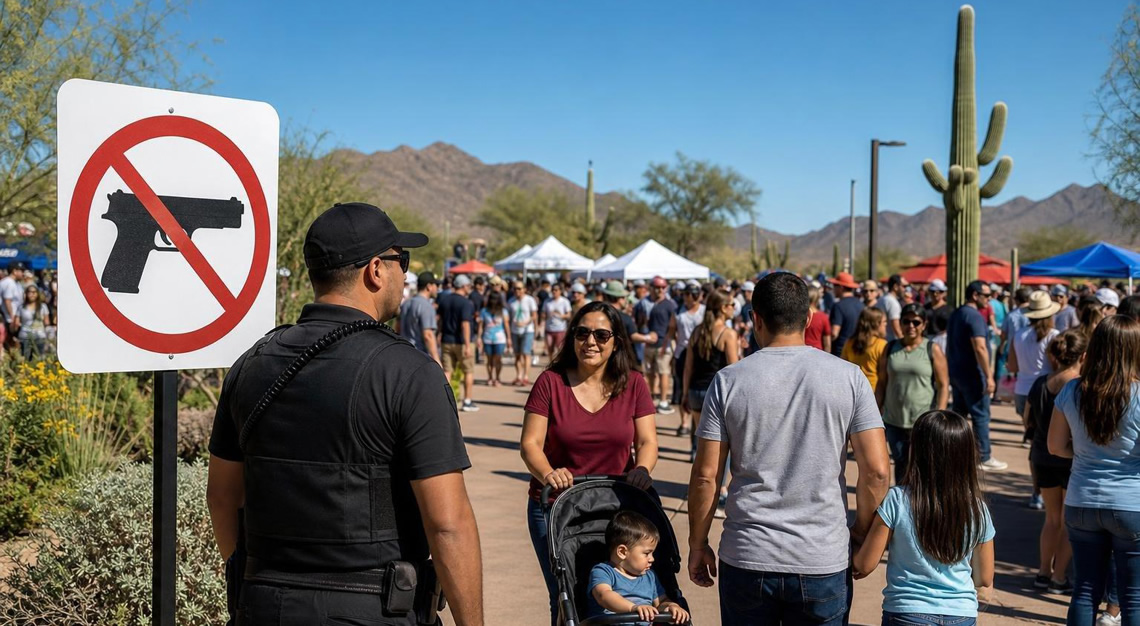
Arizona law allows organizers of ticketed events to implement firearm restrictions. State law permits sporting events, concerts, festivals, and fairs to require security screenings and prohibit weapons inside their boundaries.
Major venues across the state enforce strict no-gun policies. These include professional sports stadiums, concert halls, and baseball fields in the Phoenix and Glendale areas. City-sponsored festivals throughout metro areas also commonly restrict firearms.
Event organizers actively enforce these policies. Law enforcement makes arrests when attendees attempt to bring weapons into secured venues despite posted restrictions.
Rights of Property Owners
Business owners and property managers have legal authority to ban firearms on their premises. This applies to restaurants, bars, movie theaters, casinos, shopping centers, and other commercial spaces.
Property owners can communicate firearm restrictions through:
- Posted signage at entrances
- Verbal notice from staff
- Written policies or entry conditions
If you carry a firearm onto property where weapons are prohibited, you must leave when asked. Refusing to comply can result in trespassing charges and weapons-related criminal counts.
Locations Serving Alcoholic Beverages
Arizona law creates specific restrictions for venues that serve alcohol. You cannot legally carry a firearm while under the influence of alcohol or drugs in any public location.
Consuming alcohol while armed can lead to criminal charges. This applies even in places that would otherwise allow firearms. The combination of weapons and intoxication creates serious legal consequences.
Demonstrations and Permitted Public Activities
Temporary firearm restrictions can affect public spaces during large gatherings. Cities and counties may establish limited no-gun zones through event permits for political demonstrations, rallies, and government-approved activities in parks or streets.
These temporary restrictions can apply to people simply passing through the area, not just event participants. Before attending or traveling near large public events, check current firearm policies for that location and date.
Other Restricted Areas: Airports, Jails, Hospitals, and More
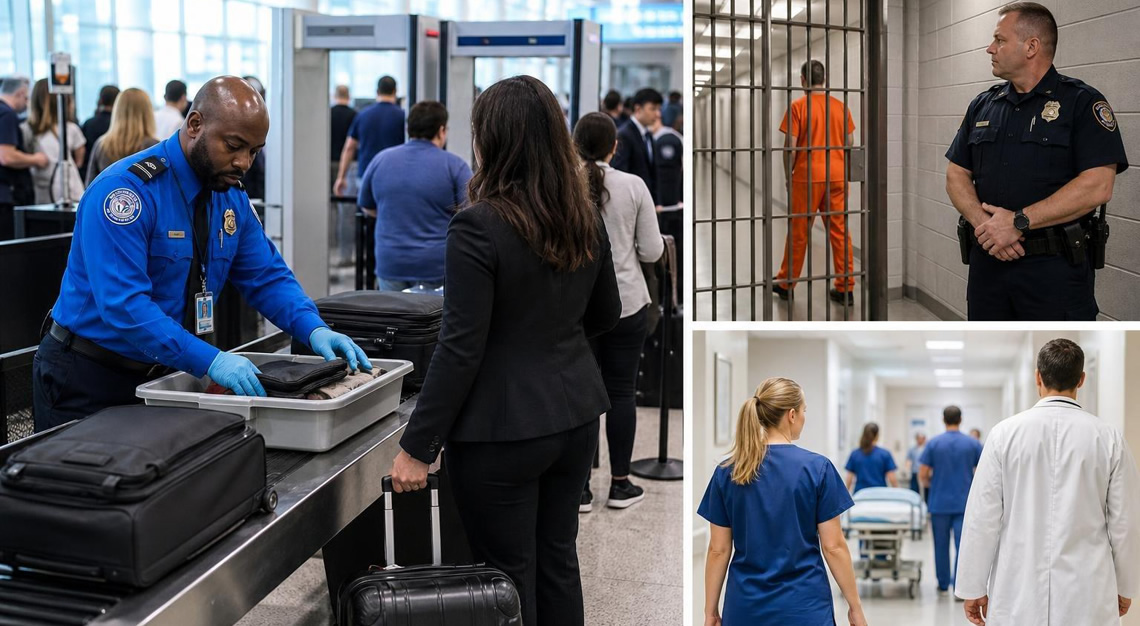
Airports
Federal law and TSA regulations prohibit firearms in secured airport zones and on planes. You can only transport guns in checked luggage if you declare them properly and keep them unloaded. TSA records show that hundreds of firearms are seized each year at Arizona airports when travelers attempt to bring them through security checkpoints.
Correctional and Detention Facilities
You cannot bring firearms into jails, prisons, juvenile detention centers, or other secure holding facilities. Only authorized law enforcement officers are exempt from these restrictions. If you violate these rules, you could face felony charges and significant prison time.
Hospitals and Mental Health Facilities
Many Arizona hospitals and behavioral health centers restrict weapons through posted signs, internal policies, and state regulations. You will commonly find restrictions in these areas:
- Emergency departments
- Psychiatric units
- Secure treatment zones
The rules vary by facility, so you should check specific policies before entering with a firearm.
Places of Worship
Churches, mosques, synagogues, and temples can create their own firearm policies. Many use signs or verbal notices to inform visitors that weapons are not allowed. If you refuse to leave when asked, you may be charged with trespassing.
Indian Reservations and Tribal Lands
Tribal nations operate under their own legal systems and can set firearm rules that differ from Arizona state law. The Navajo Nation, Gila River Indian Community, and Salt River Pima-Maricopa Indian Community each maintain distinct regulations. Some tribes ban firearms completely while others require special permits.
Your Arizona carry permit does not apply on tribal land. If you violate tribal firearm laws, you could be detained, cited, or prosecuted in tribal, state, or federal court.
Military Bases
Arizona military installations like Luke Air Force Base, Davis-Monthan Air Force Base, and Fort Huachuca follow strict Department of Defense policies. You typically cannot bring personal firearms onto these bases. When allowed, weapons must be registered and stored in designated armories.
Jurisdictional boundaries change quickly in Arizona. What is legal on state land may be prohibited just steps away on federal or tribal property.
What Happens If You're Caught Carrying Where It's Not Allowed
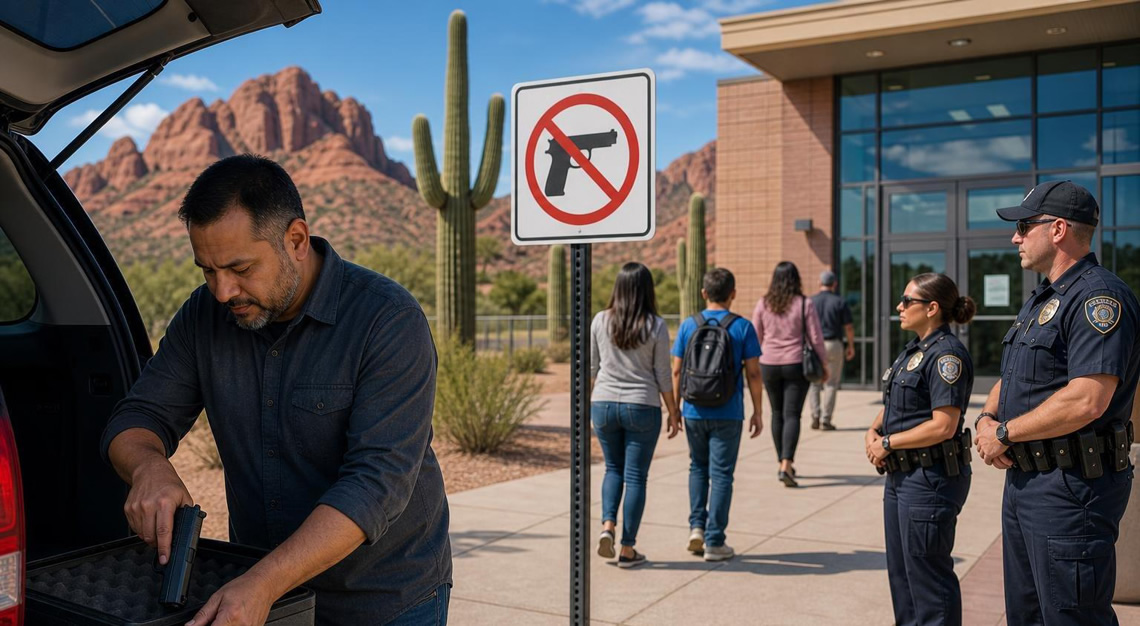
State-Level Violations
If you carry a gun where Arizona law says you can't, you'll likely face a "misconduct involving weapons" charge under state statute. The severity depends on the specific facts of your case.
Your punishment can range from a misdemeanor to a felony. A Class 1 misdemeanor can put you in jail for up to six months and result in fines. A Class 4 felony carries much harsher consequences—between 1.5 and 3 years in prison and fines that can reach $150,000.
Several factors can make your penalties worse. If you have prior convictions, a history of violent crimes, or your actions created a risk of serious harm to others, the court can increase your sentence.
National-Level Violations
Federal law creates its own prohibited locations. If you carry a gun in a federal building or within a school zone, you can face charges under separate federal statutes.
The consequences include:
- Fines of $100,000 or higher
- Federal probation terms
- Time in federal prison
- Loss of your right to own guns permanently
Recent Supreme Court decisions have required all states to allow concealed carry with or without permits. However, these rulings haven't changed the laws about schools or federal facilities. You still can't carry in these places even though carry rules have expanded elsewhere.
Ways to Challenge These Cases
Your attorney can raise several issues when defending against these charges. The strength of your case often depends on specific details that the prosecutor must prove.
Key defense questions include:
- Were warning signs posted correctly and visibly as the law requires?
- Did you actually know you were on restricted property?
- Was your firearm locked and unloaded inside your vehicle?
- Do you fall under any legal exceptions for law enforcement or security personnel?
- Was your gun stored properly in a locked compartment?
The law does create narrow exceptions for certain people and situations. However, you shouldn't try to interpret these exceptions on your own without legal help.
Your lawyer can examine police reports, video recordings, posted signs, and property boundaries to find weaknesses in the state's case. They can also work to negotiate reduced charges.
You should not give detailed statements to police about carrying a gun in a restricted area until you talk to an attorney first.
Common Questions About Carrying Firearms in Arizona
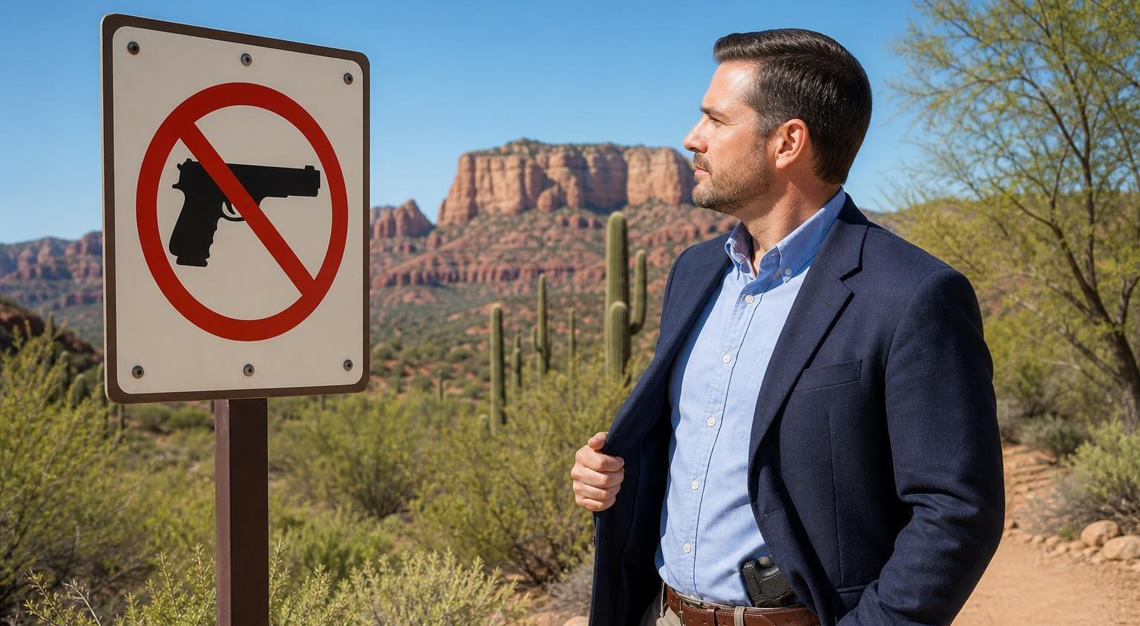
Are you allowed to bring a concealed firearm into bars or restaurants that serve alcohol?
Arizona law permits carrying in many businesses that serve alcohol, but certain restrictions apply. If an establishment displays a clear "no firearms" sign at the entry, you cannot bring a gun inside.
Carrying while intoxicated is illegal regardless of whether signs are posted. Law enforcement and prosecutors take these situations seriously.
Any combination of alcohol and firearms can lead to criminal charges. If you face accusations related to carrying in drinking establishments, you need to understand how the specific facts of your case align with state statutes.
Can you store a gun in your vehicle on school grounds?
Arizona law provides narrow exceptions for firearms in vehicles at schools. These exceptions typically require the gun to be unloaded and locked away securely.
Many factors determine legality. Whether you exit the vehicle while armed, if students could access the weapon, and what written policies the school maintains all matter.
Federal law also applies near schools. The Gun-Free School Zones Act has its own set of rules and exceptions that may affect your situation.
Anyone who regularly drives to K-12 schools should verify the rules before keeping firearms in their vehicle on campus.
Do permitless carry laws work on tribal lands?
Tribal lands operate as sovereign territories. Each tribe creates its own firearms regulations independent of Arizona state law.
These tribal rules can be much stricter than state requirements. Some tribes ban concealed carry entirely or require special permits issued by the tribe itself.
You cannot assume that legal carry under Arizona law extends to reservation property. Even if you legally carry everywhere else in the state, tribal police may confiscate your weapon or pursue charges if you violate tribal codes.
Non-tribal members should research specific tribal regulations before entering reservation boundaries. If you encounter legal issues with firearms on tribal land, the situation may involve both tribal and federal jurisdiction.
Can your workplace ban all firearms, including those in parking lots?
Employers in Arizona can restrict guns inside buildings and on company property through written policies. Violating workplace gun policies can result in disciplinary action or job termination.
State law addresses firearms locked in personal vehicles in employee parking areas, but the details are complex. Whether the parking lot is secured, if you own the vehicle, and whether the gun is visible all affect the legal analysis.
Key factors in workplace gun cases:
- Type of employer property
- Vehicle ownership
- How the firearm is stored
- Specific company policies
- Whether charges are criminal or employment-related
Employment law and criminal law can intersect in these cases. Anyone facing workplace consequences or criminal investigation needs specific legal guidance.
What steps should you take if you unknowingly entered a "no guns" location?
Leave the premises immediately and calmly once you notice your mistake. Do not touch or adjust the concealed firearm while still inside or in public view.
If security or police are already involved, stay calm and polite. Do not make detailed statements before speaking with legal counsel.
The outcome depends on several factors. Private businesses handle these situations differently than government buildings. Your response and behavior also matter significantly.
Important considerations:
- Type of location you entered
- Whether signage was properly displayed
- Your intent and actions upon discovery
- How you interact with authorities
Whether you receive a warning, trespass notice, or criminal charge varies by circumstance. If authorities cite, arrest, or question you, obtain legal representation quickly to protect your rights and review possible defenses.
When to Contact a Lawyer About Gun and Weapons Charges in Arizona
You should get legal help right away if you face any arrest or investigation related to carrying a gun in a restricted area. Arizona takes these charges seriously when they involve schools, government buildings, airports, or public events. Prosecutors and law enforcement focus heavily on these cases because of public safety concerns.
A weapons charge can damage your future even if this is your first offense and no violence occurred. You may face problems with:
- Your criminal record
- Professional licenses you hold
- Immigration status
- Your right to own guns later
Act quickly if you have been arrested, cited, or given a court date for any gun possession charge. Do not wait to see what happens. A criminal defense attorney can review the facts of your case and explain which laws apply to your situation. They can also identify defenses that may help you.
Contact a criminal defense lawyer for a confidential consultation if you are under investigation or have already been charged. An experienced attorney understands Arizona gun laws and can protect your rights throughout the legal process.
Contact Phoenix Criminal Lawyer criminal defense attorneys at (602) 600-0447 to schedule a consultation. Our legal team is ready to discuss your case and develop a defense plan tailored to your specific situation.


